Keynote Speakers
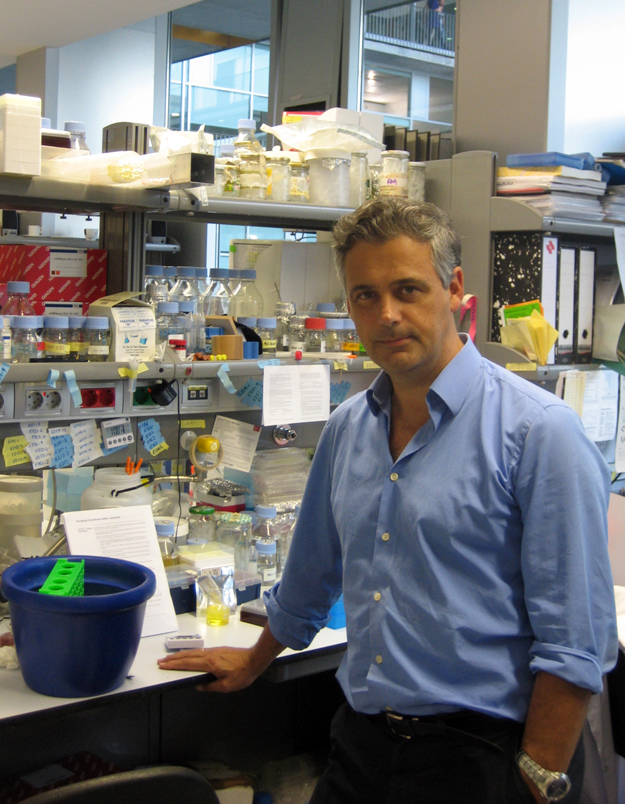
Luis Serrano
Center for Genomic Regulation
Homepage: http://crg.es/luis_serrano
|
|
The group of Luis Serrano is interested in the quantitative understanding and in the rational design of Biological Systems. To achieve this goal they combine theoretical and experimental approaches and develop appropriate software. Of particular interest for the group is the combination of protein design and network analysis to understand signal transduction and gene regulation. As a more ambitious project the group is part of a consortium with the EMBL in Heidelberg aiming at obtaining for the first time a global quantitative understanding of a living system, Mycoplasma pneumonia. |
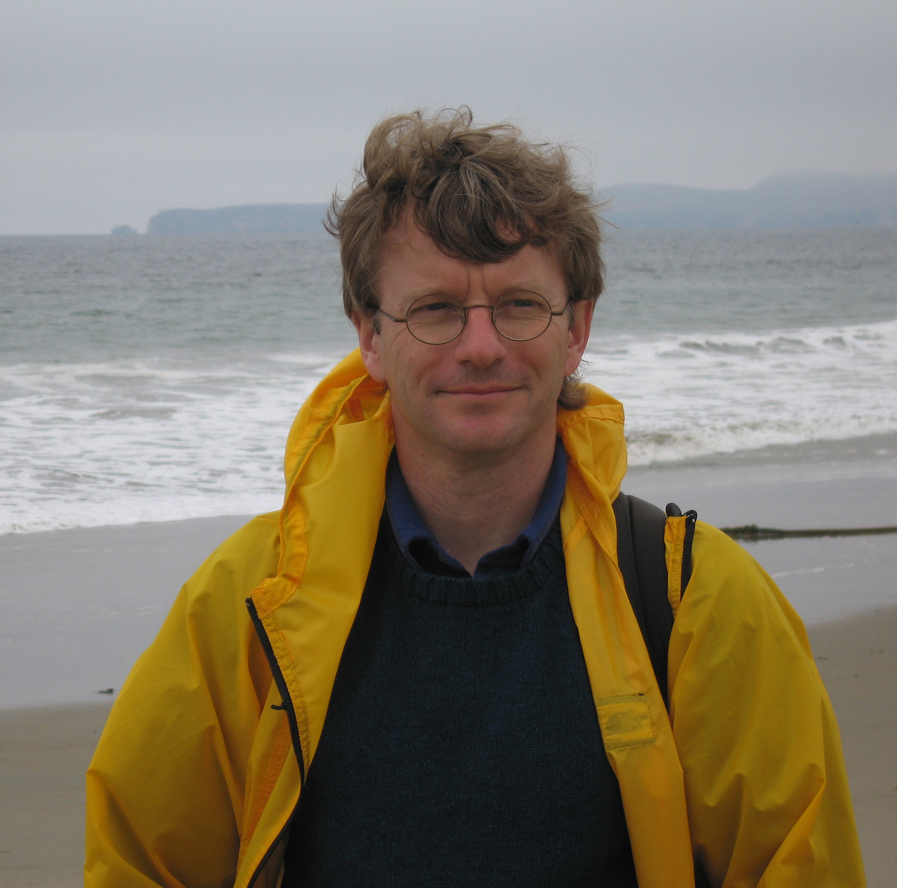
Mark Biggin
Berkeley National Laboratory
Homepage: http://www.lbl.gov/gsd/biggin.html
|
|
In vivo, animal transcription factors each show a quantitative continuum of DNA binding to highly overlapping sets of genomic regions that are located close to most genes. These continua span functional, quasi-functional, and non-functional DNA binding events, with factor regulatory specificities being distinguished by quantitative differences in DNA occupancy patterns. Using the Drosophila blastoderm embryo as a model, we are developing computational models that describe the biochemical mechanisms that produce these patterns of DNA binding and how combinations of transcription factors cooperate to generate spatial and temporal gene expression. |
Albert Goldbeter
Université Libre de Bruxelles
Homepage:http://www.ulb.ac.be/sciences/utc/GOLDBETER/agoldbet.html
|
|
Rhythmic phenomena can be observed at all levels of biological organization. The molecular mechanisms responsible for these periodic processes generally involve various complex feedbacks and threshold phenomena. We use mathematical models to elucidate the molecular bases of these rhythms. This theoretical approach, which is closely based on experimental data, contributes to a thorough understanding of the oscillatory phenomenon. Moreover, theoretical models lead to predictions which can in turn be tested experimentally. We also focus on other nonlinear phenomena related to oscillations that can be observed in biology, such as bursting, chaos, excitability (the ability of a system to amplify a suprathreshold perturbation), bistability (the coexistence between two stable steady states), and the spatial propagation of biochemical waves. |
Nikolai Kolchanov
Institute of Cytology and Genetics SB of RAS
Homepage: http://www.bionet.nsc.ru/labs/theorylabmain/ltg.php?f=people&p=Kolchanov
|
|
Nikolai Kolchanov is a member of the Russian Academy of Sciences and heads Institute of Genetics and Cytology of the SB of RAS. Professor Kolchanov’s group performs theoretical investigation of biological systems and human genome in particular and develops different tools to support research in the area of systems biology and bioinformatics. |
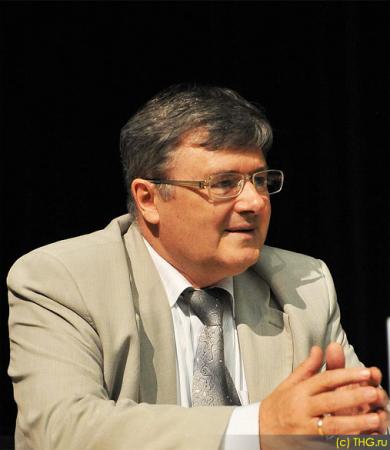
Mikhail Gelfand
Russian Academy of Sciences and Moscow State University
Homepage: http://www.rtcb.iitp.ru/mg_e.htm
|
|
Mikhail Gelfand works in various areas of molecular evolution, comparative genomics and systems biology. His research interests include evolution, regulation and function of alternative splicing; evolution of reglatory networks in prokaryotes; co-evolution of transcription factors and the DNA motifs they recognize; microevolution of bacteria on the level of strains, species and genera, metagenomics. |

